Showing posts sorted by relevance for query statice. Sort by date Show all posts

Wednesday, 3 March 2010

the downfall of the statice

I love my perennial statice (Limonium perezii) and I've spoken of them a few times.  I planted them almost exactly a year ago and they've been in bloom almost constantly ever since.  I've known from the beginning that they prefer full sun but their shady spot didn't seem to bother them, they've absolutely thrived.

Well.  Until now anyway.

A few weeks ago I noticed them slightly wilt.  I thought they needed water, which is a bit odd because they've never needed a drop of extra water.  Turns out they definitely didn't need water, they needed treatment for powdery mildew.  This is what they looked like at first, and what the one in the sunnier position still looks like:
http://www.alexareynolds.com/garden10/staticemildew2.JPG
The one in the shadier spot was looking much, much worse.
http://www.alexareynolds.com/garden10/staticemildew1.JPG
I'm familiar with powdery mildew on pumpkin and other vegetables but didn't realise it could hit perennials.  But a closer look under the leaves confirmed it.
http://www.alexareynolds.com/garden10/staticemildew3.JPG
In retrospect it's a perfect recipe for powdery mildew - shady, dense leaves, and when I took a look under the leaves there were layers and layers of dead leaves underneath.  Thick matted foliage like that keeps the air from circulating and encourages mold.

The plant in the shadier spot was so far gone that I took a punt and chopped all the leaves off - they were dying so quickly anyway. When it's that far along, fungicide sprays can only do so much.  So I hacked it back to this and doused the stumps in fungicide.  Let's hope its tough nature lets it bounce back. 
http://www.alexareynolds.com/garden10/staticemildew4.JPG
The second plant I decided to cut out all the dead leaves, the flowers, and several handfuls of healthy leaves too.  Each leaf got a spray on top and bottom and I'm hoping it will fight back.

Even if they die, I've decided I'll replace them with statice.  Next year in the summer I'll be sure to cut out all the dead foliage and I'll try using a milk spray a few times in the summer.  Milk spray puts "good" critters on the leaves that don't leave room for "bad" mildew.  It won't work after the mildew sets in but it could head it off next year.

Wednesday, 30 June 2010

a big swap for a little maple

My sad little Japanese maple has now survived two summers in its spot in the corner of the back garden.  The first summer was brutally hot and dry and it barely survived.  This summer was a lot more mild, but it still looked a bit rough by the autumn.  I'm not one for babying my plants and it obviously doesn't like where it lives.  So once it lost its leaves I decided it was time for a change.
http://www.alexareynolds.com/garden10/swap1.JPGThis is what the back garden looked like before.  I've pulled out the marigolds and nasturtium for the winter.  One of the statice died a while back, the other was looking shocking so I pulled it out too.  There on the right is a taro plant, a very tough root-based plant that seems to be thriving on neglect.  It's even put out two little babies.

I decided that the maple would prefer the spot where the taro is now.  It's on the south side of a tall fence, sheltered from the hot summer sun.  And it's a higher spot, rather than being completely hidden in that far corner.

http://www.alexareynolds.com/garden10/swap2.JPGThis is the corner where the maple lived.  I carefully dug it up, trying not to tear the roots and getting as much of the root ball as possible.  The roots actually looked very healthy, they'd spread out quite a bit in the last year or two.  Very shallow though, as these trees tend to be.  I trimmed off the dead twigs - yes, more dead twigs, it seems to be shrinking rather than growing - and hoped that I didn't need to trim off any viable twigs.  You're generally meant to do that when you transplant, because you always lose some roots and the roots can't support the same amount of foliage.  But since it's still early winter, I'm hoping I can get away with it and rely instead on frequent doses of seaweed solution to nourish the roots. 

http://www.alexareynolds.com/garden10/swap4.JPGHere's the taro in its new home.  It'll get a bit more sun here than it did in its old home and I'm hoping it really takes off.  They can get even bigger than this, so if anything it now has even more room to grow than in its old home.

http://www.alexareynolds.com/garden10/swap3.JPGAnd there on the right is the maple tree in its new home.  It looks so much taller when it's actually at ground level!  And I discovered that the soil in that corner is pretty much pure sand.  Not a single worm to be seen.  I dug out a fair bit of the sand and instead dug in some more of that super-rich manure/soil mix I still have from months back, chock full of worms.  No fertilizer though, don't want to burn the roots. 

You can't really see in the photo but there's another impromptu new addition.  Where the statice used to be are two baby taro plants.  Full-grown they'll be way too big for those positions, but I reckon they've got a year or two of growing first.  After that I'll find them another home.  And in the long term, the vitex in the main bed will eventually grow to be about two metres tall and spreading, shading a lot of this are (I hope!).  The oakleaf hydrangeas in the narrow beds will start to fill out too.  This part of the garden really is still a young work in progress, which in a way is far more exciting than the established plants at the front.

Sunday, 24 January 2010

melon sex, bees and marigolds

http://www.alexareynolds.com/garden10/melonflower.JPGLast year I learned a lot about pumpkin sex: how to tell the male and female flowers apart, how to hand-pollinate, and how to tell if the pollination worked.  This year I've had to learn how rockmelons and watermelons get busy.  The biggest difference is that the flowers are smaller and there are a helluva lot more of them.  But I couldn't tell if there were male and female types as there are with pumpkins.  It turns out that was because for the last month it's only been making male flowers.  I'm finally starting to notice more and more of these little ladies with their little baby melons.  They're not easy to spot but it doesn't seem to matter because they're not really practical to hand-pollinate.  I just have to hope that the bees visiting the nearby statice and lavender stop by the melon patch.  I already know that some didn't pollinate properly because a few mini-fruit are yellow which I assume means they're about to drop off.  Hopefully the rest start taking soon.

http://www.alexareynolds.com/garden10/melonsjan2.JPGI thought I'd compare this patch to where it was last year at about this time.  I was behind schedule this year because I was giving the granex sweet onions a bit of extra time to ripen.  I wish I hadn't bothered because I am indeed behind schedule; at this time last year I had potimarrons the size of two fists put together.  However the pumpkin vine did last until April last year so hopefully I'll get at least a few watermelons, rockmelons and pumpkins.

Speaking of pollination, I've been paying attention this year to which flowers attract the most bees.  They seem to love the lavender, like the statice, and adore the African blue basil (which is near the bird bath, unfortunately, and not near the pumpkins and melons!).  I haven't seen them on the marigolds or the alyssum that's self-sewn around the place.  They also loved the catnip before I tore it out. 

http://www.alexareynolds.com/garden10/bluebasilbee.JPGThis afternoon I stalked a few bees and his is my favourite photo of one on the African blue basil.  It's a great plant, not a basil for eating but it still smells amazing, it has lovely green and purple leaves and it gets these incredibly long flower stalks.  I believe it's a perennial and over-winters better than culinary basils.  You don't have to worry about it going weedy as the seeds are sterile, but you can propagate it easily from cuttings.  This little bee was hard to snap because he was dashing about so quickly.  If you have problems with pollination in your garden, I highly recommend this plant or its relatives.

And finally, I also got distracted by the marigolds.  I started them from seeds (a French variety called "Sparky" from Eden Seeds) and the ones that get the most sun have grown up into gorgeous plants.  I loved all these photos so I thought I'd share all three.
http://www.alexareynolds.com/garden10/marigolds1.JPG

http://www.alexareynolds.com/garden10/marigolds2.JPG

http://www.alexareynolds.com/garden10/marigolds3.JPG


Thursday, 7 January 2010

back corner and veggies

The back corner garden is also coming into its own.  This is what it looked ago about 18 months ago, not long after I moved here.  Pretty desolate place innit.
http://i333.photobucket.com/albums/m362/little_garden/newgarden1.jpg?
This is what it looks like today.  Marigolds and nasturtium, perennial statice, and the dichondra "silver falls" is really coming along.  I planted it hoping it would drape over the brick to shade it a bit and keep the roots of the oak-leaf hydrangea from getting too hot.
http://www.alexareynolds.com/garden10/backcornerjan.JPG
The melons back there are coming along well, you can just see the Minnesota midget is starting to grab onto the wall.  The watermelon in the tub is doing ok too and the pumpkin is now covered with both male and female flowers.
http://www.alexareynolds.com/garden10/melonsjan.JPG
Unfortunately despite some hand-pollination it doesn't look like any of the female babies have set.  Something I learned last year is that if the pollination "takes", the pistil (the female part of the flower) sticks to the fruit as it first starts to swell and grow.  These ones, as you can see, have a flat end because the pistils fell straight off.  I could be wrong but I'm pretty sure this means they didn't pollinate.  No worries, it's still a small vine, it's got plenty of growing to do.
http://www.alexareynolds.com/garden10/pumpkinduds.JPG
And although these are on the front porch, not the back corner, I wanted to update you on the tomatoes.  I've not eaten 3 or 4 of my lovely little Tommy Toe tomatoes and eagerly awaiting the first rouge de marmande ripening.  I took a photo to show you why I'm impatient.  They've reached a lovely size and may be still growing.  Most of the bunches are quite full, one of the clusters in this photos has 6 of these puppies all squeezed together! 
http://www.alexareynolds.com/garden10/rdms.JPG
When will you be ripe!!?

Unfortunately I lost a full set of RdM blossoms before I realised they weren't getting enough water.  So there's one "layer" of almost-ripe fruit, one empty layer of no fruit where all the blossoms dropped, and finally a new layer where it seems the fruit has properly set.  The Tommy Toes didn't have this problem, they kept powering along all the while.


Sunday, 11 April 2010

winter plans

http://www.alexareynolds.com/garden10/needfill1.JPGI've been thinking hard about two places in the garden that need work.  The first is the big square bed that used to be the fish pond, pictured here.  After filling it in last year I've spent the year growing vegetables in it whilst I decide what to do in the long-term.  Vegetables aren't a good long-term solution because only the bottom left corner gets enough sun, which is an awful waste of the other 3/4 of the bed.

So I've spent over a year considering what to plant instead.  I really wanted to plant a fruit tree of some kind but I just don't think it'll work.  Most are too big - citrus would want more sun - most smaller fruit trees need pollinators.  So then I moved to considering small ornamental trees like a crepe myrtle.  I want something that will grow a few metres and spread out in a pleasant umbrella shape.  I think this part of the garden would appreciate some proper "dappled shade".  It's a funny mix of boiling-hot sun and deep shade with not a lot in between, and the left-hand bed gets a lot more sun than the right-hand bed.  A spreading tree of summer shade will even this out, letting me plant shadier plants on both sides.  I have dreams of Japanese windflowers to replace the Statice some day (as it's a sun-lover), and probably some more hellebore since it seems to be doing pretty well in the other bed.  A small spreading tree would also be a nice compliment to the oakleaf hydrangea, which will read a decent size in time.  Wouldn't want anything too small or it would be dwarfed by the hydrangeas.

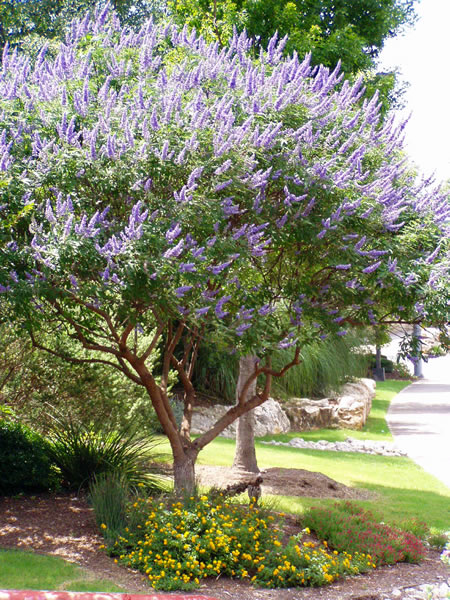
But to be honest I'm not crazy about crepe myrtles and again there's a slight concern it wouldn't get enough sun.  Then finally, a wonderful suggestion from the OzGrow forum, a small tree I've never heard of before called Vitex agnus-castus.  Like the crepe myrtle it's a small deciduous shrub or tree, but instead of white or pink flowers it makes long crazy spikes of purple.  Purple suits me much better, and all the other flowers in that corner are either purple or orange/yellow.  Vitex also tolerates shade better than crepe myrtle.  Hopefully it'll look like this.

http://www.alexareynolds.com/garden10/needfill2.JPGThe other tough spot is behind the house where the camellias used to be.  I've considered a number of option but I think I'll go with Murraya paniculata, also known as mock orange or orange jasmine.  It's a member of the citrus family, tough and not fussy, but I was sold on it when I walked past a hedge in flower.  It has the most heavenly scent of orange blossom you can imagine, it actually stopped me in my tracks.

After a bit of deliberation I decided to save the last two pine bushes even though I really don't particularly like them.  Hedges aren't cheap and leaving them means I can buy two less Murraya than otherwise.

But before I undergo either project I need to top up those beds.  I've learned that soil tends to sink quite a bit after a while so it's important I fill up the beds as much as I can.  Which meant a call to Fulton's garden supplies for a big pile of dirt and another of barkdust.

http://www.alexareynolds.com/garden10/dirtpiles.JPGI only ordered a cubit metre of soil and a half-metre of barkdust but I reckon I got a lot more than I paid for!  Just like last year I now have a big pile of dirt in the driveway.  It's a lovely soil called a "three-way" mix of two soils and horse manure.  It's quite light and friable and full of organic matter which is just the thing for my beds.  I have so much extra I'll probably spread the love into some of the beds with really inorganic "builder's rubble".

http://www.alexareynolds.com/garden10/needfill3.JPGI've filled up a fair bit now as you can see, hopefully some of the dirt will settle and I can pile on some more.  I've certainly got plenty of time, winter's the best time to plant deciduous trees. 

Exciting times ahead for this winter!

Sunday, 20 September 2009

happy little maple, the back bed, and favourite flowers

http://www.alexareynolds.com/garden09/mapleleaves.JPGI'm glad to announce that the sad little maple tree survived its ordeal.  As you can see the tips of the longer branches have died, although some of them have buds that haven't sprouted yet.  But I'm very proud of its tenacity, and I hope that this year is kinder to it than last year.  Hopefully I'll remember to water it more often!  In the meantime it's going to get some coffee grinds around the roots this weekend.  It loves acidic soil and the grinds should keep the surface roots cool.  I just had to learn the hard way last year, only to put a thin layer of grounds.  Anything as thick as even 1cm turns into a hard caked crust!

http://www.alexareynolds.com/garden09/cornersept.JPGI thought I'd add a picture of the back bed whilst I was at it.  The pansies in the raised beds are doing OK but I don't think I'd plant them back there again.  They want more sun, the blooms are large but don't last long, and any bit of rain makes them flop over.  Compare that to the smaller violas I describe in a moment...

In the meantime the oakleaf hydrangeas are starting to wake up from winter dormancy (they're too stick-like to see in the photo but they're near those lamps in the raised beds).  I also wanted to bring the perennial statice to your attention, it's those clusters of broad dark leaves with the whispy purple flowers.  They are fabulous plants, the blooms last forever, all through the autumn.  And when the autumn flowers faded it had already put out another set of buds which bloomed with the spring.  Two long shows per year, and they're tough and drought-friendly.  A great find for any Melbourne garden.

The big bed in the middle is full of manure and waiting for this year's veggies.  I'm thinking I'll try edamame soybeans, the kind you eat freshly steamed as a snack.  It's a Japanese snack I highly recommend if you haven't tried them.

http://www.alexareynolds.com/garden09/violassept.JPGAs promised, here's another look at the violas at the front door.  Now you can see why I prefer them to the pansies ... they put out so many cheerful blossoms and they've done so all winter long.  The trick is to pick off the spent flower heads every so often so they spend their energy making more flowers instead of making seeds.  Will definitely grow again next winter.

http://www.alexareynolds.com/garden09/geraniumssept.JPGNext we have probably my all-time favourite flower, geraniums (pelargoniums).  I keep showing photos but I can't help myself.  I can't quite get over that twelve months ago these were tiny seedlings with maybe six leaves.  And now they're going nuts!  This is the cluster that's done so well I've had to prune it back already.

http://www.alexareynolds.com/garden09/cliviabloom2.JPGMy clivias are doing well too.  I planted them in the autumn and they've all put out new growth, though only one decided to bloom this year.  But what a bloom!  This variety is meant to blossom twice a year, so maybe by the autumn all three plants will be ready to bloom at once.  And in the meantime, I think one of them has had a baby.  You can just see a little green leaf coming out of the bark in front of the parent.  I think it's a "pup", which would be great, I'd love to have a thick cluster of clivia in this bed.  Though I can't recommend them yet as they haven't survived a Melbourne summer yet...
http://www.alexareynolds.com/garden09/cliviabloom1.JPG
And finally, another flower I can't yet recommend because I don't know if it'll survive the summer.  My hellebores survived a vicious aphid attack, and one of them decided it was ready to flower this year.  I'm very happy with the colour, they came from a mix so I didn't know what colour they'd be.  They go semi-dormant over the summer so I hope that means they'll survive the heat.
http://www.alexareynolds.com/garden09/hellebore2.JPG


Sunday, 8 March 2009

the dirt is in

http://www.alexareynolds.com/garden09/ponddirt1.JPGWell I finished filling up the goldfish pond, including a layer of my acidic compost and a layer of coffee grounds.  Unfortunately I still have a half-pile of sh*t in the driveway.  Not sure what I'm going to do about that.

I've planted two rows of peas along the back and a row of lettuce at the front with plans to put some onions between.  I don't really care if any of that comes to fruit, it's more to settle the soil in over the winter.  And the peas are nitrogen fixers which means they take nitrogen from the air and store it in their roots; when you're done growing them you cut off the stems and leave the roots to enrich the soil.

http://www.alexareynolds.com/garden09/ponddirt2.JPGI also wanted to share this photo because I pulled out the purple cordyline that used to be at the front of the pond.  They look good in that photo but after the heat they turned brown and ugly.  So instead I planted perennial statice (Limonium perezii).  They'll get about twice the size you see here over the next year or two, and they put out those lovely purple flowers in autumn.  I think the flat, rounded leaves (which in an adult plant are about the size of a hand with fingers open) will be a nice visual contrast to the strappy grasses around it.  And they're tough as nails, a must-have for any flowers I'm going to bother with.