I've been thinking hard about two places in the garden that need work. The first is the big square bed that used to be the fish pond, pictured here. After filling it in last year I've spent the year growing vegetables in it whilst I decide what to do in the long-term. Vegetables aren't a good long-term solution because only the bottom left corner gets enough sun, which is an awful waste of the other 3/4 of the bed.
So I've spent over a year considering what to plant instead. I really wanted to plant a fruit tree of some kind but I just don't think it'll work. Most are too big - citrus would want more sun - most smaller fruit trees need pollinators. So then I moved to considering small ornamental trees like a crepe myrtle. I want something that will grow a few metres and spread out in a pleasant umbrella shape. I think this part of the garden would appreciate some proper "dappled shade". It's a funny mix of boiling-hot sun and deep shade with not a lot in between, and the left-hand bed gets a lot more sun than the right-hand bed. A spreading tree of summer shade will even this out, letting me plant shadier plants on both sides. I have dreams of Japanese windflowers to replace the Statice some day (as it's a sun-lover), and probably some more hellebore since it seems to be doing pretty well in the other bed. A small spreading tree would also be a nice compliment to the oakleaf hydrangea, which will read a decent size in time. Wouldn't want anything too small or it would be dwarfed by the hydrangeas.
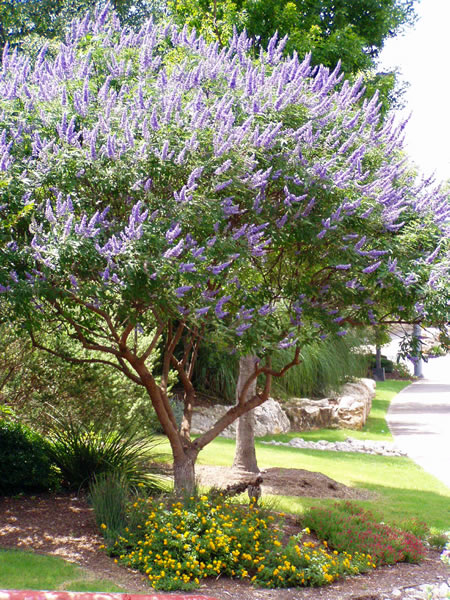
But to be honest I'm not crazy about crepe myrtles and again there's a slight concern it wouldn't get enough sun. Then finally, a wonderful suggestion from the OzGrow forum, a small tree I've never heard of before called Vitex agnus-castus. Like the crepe myrtle it's a small deciduous shrub or tree, but instead of white or pink flowers it makes long crazy spikes of purple. Purple suits me much better, and all the other flowers in that corner are either purple or orange/yellow. Vitex also tolerates shade better than crepe myrtle. Hopefully it'll look
like this.

The other tough spot is behind the house where the camellias used to be. I've considered a number of option but I think I'll go with Murraya paniculata, also known as mock orange or orange jasmine. It's a member of the citrus family, tough and not fussy, but I was sold on it when I walked past a hedge in flower. It has the most heavenly scent of orange blossom you can imagine, it actually stopped me in my tracks.
After a bit of deliberation I decided to save the last two pine bushes even though I really don't particularly like them. Hedges aren't cheap and leaving them means I can buy two less Murraya than otherwise.
But before I undergo either project I need to top up those beds. I've learned that soil tends to sink quite a bit after a while so it's important I fill up the beds as much as I can. Which meant a call to Fulton's garden supplies for a big pile of dirt and another of barkdust.

I only ordered a cubit metre of soil and a half-metre of barkdust but I reckon I got a lot more than I paid for!
Just like last year I now have a big pile of dirt in the driveway. It's a lovely soil called a "three-way" mix of two soils and horse manure. It's quite light and friable and full of organic matter which is just the thing for my beds. I have so much extra I'll probably spread the love into some of the beds with really inorganic "builder's rubble".

I've filled up a fair bit now as you can see, hopefully some of the dirt will settle and I can pile on some more. I've certainly got plenty of time, winter's the best time to plant deciduous trees.
Exciting times ahead for this winter!
 I made my first baguettes this weekend, using the bread machine to knead and shaping by hand. It was a "rustic" recipe of white bread flour with a bit of rye. I wanted to document how it went so I can look back on this and laugh.
 Overall though, not a bad effort! The crust was very thick with a good hearty tear to it and the flavour was lovely. But next time I'm hoping the inside will be a bit lighter and fluffier. And to be honest, I reckon this style of rustic thick crust is better for a batard (oval shape) than a baguette. But this is part of the joy I get from making bread - I learn so much from every loaf!
 The castings are wonderfully rich, like very soft clay, and no they don't smell like poo they just smell like dirt. It's a pure, super-injection of moisture-retaining organic life. You can put it as-is into the ground when you plant things, or it dissolves really easily in water into a kind of slurry, which is good for rejuvenating tired potting mix. Some of my beds are a thin layer of good soil over a dense layer of inorganic builder's rubble, which makes it hard to enrich the deeper layers without disturbing plant roots. But this liquid slurry should be able to seep down into the poor soil and help bring it to life. I'm looking forward to seeing how worm poo power improves my garden!
 I decided to order my murraya online. The alternatives were to buy 6 decent-sized shrubs for about $20 each, or a set of 8 seedlings for $30 total. I bought the seedlings from a mail-order nursery on eBay and they arrived promptly, well-wrapped and looking happy.
 In fact I was concerned enough I kept them inside their first night. But this weekend they went in to their new homes in the back garden bed. They're so small there's no point taking a photo down the whole line, you wouldn't be able to see them! The soil I've infilled with is incredibly moisture-retaining which is great because the old soil below it is very sandy and poor. I just hope it's not too boggy to be honest. But so far they're doing fine, they haven't dropped dead yet!
 What do you reckon, is my broccoletti a bit oversized? My broccoli last year never got leaves this big! And they're a bit brittle, two leaves have already snapped off. It also got attacked by aphids a few weeks back and even though I killed them off quickly, it sure warped that set of leaves badly (not pictured, they're only half the size of this monster and misshapen). In any case, I wonder if I went a bit too heavy on the fertilizer pellets, though the kale is normal sized.
 The gai lan is already at harvest size, at least I think so, because it's forming little heads. I'm not sure what to expect really. But I thought there would be many more leaves per stem, there are only about 6 big leaves per stem. And unfortunately they're not really edible. The caterpillars I can deal with - little holes don't bother me. But the citrus leave miners I cannot tolerate. They're all over the cumquats which doesn't really matter. But they also attacked my lettuce last year and they're all over the kale and gai lan. They're awful because they burrow into the leaf and the only way to get rid of them is to rip off the part of the leaf they're in.
 My designer twig continues to power on with another set of new growth coming in now. It's come so far since it was delivered in December 2008! But as you can see, it's starting to look a bit too large for its pot. The problem is I don't have a lot of room for another big pot! It's pretty much at the point where it would want a half-wine-barrel sized pot but I don't think one would even fit on the porch.
 Whoever planted the hebe didn't even bother to take it out of the pot. Now you might do that for something like a fig tree if you wanted to keep the size under control. But for something like a hebe I can't imagine it was anything but laziness.
 The plastic pot was a blessing in disguise because once I cut the roots I was able to leverage the pot out of the ground. Notice how the roots weren't able to grow out from the bottom, perhaps because the soil down that far was so rubbish. You can just see how at the top of the photo the soil's fairly dark and "living" but at the bottom it's pale and dry.
 First, and update on my brassicas. The broccoletti and kale and the big tub have gone absolutely bonkers! I think a few pellets of concentrated fertilizer probably helped on that front. I have, however, been battling and absolute plague of cabbage white butterflies. Just when we thought winter had begun, we got another seemingly endless streak of warmish weather. As long as the weather is warm, the butterflies will be breeding like crazy. I started by carefully scraping butterfly eggs off every day, but after a while each day there were dozens and dozens of eggs and the plants got bigger and bigger. Eventually I lost ground and a few caterpillars managed to hatch so I resorted to Dipel.
 The Chinese broccoli is also getting nibbled as you can see. I'm seeing if I can squeeze 2 into a pot but only 1 in the other pot to hedge my bets.
  I left the melons going as long as I could because the green nutmeg melon set three fruit late in the season. But unlike pumpkins, melons only ripen when there's some good heat on them. On top of that, as you can see the vine's not doing too well. It's been hit hard by powdery mildew and an absolute plague of aphids. This weekend is probably our last warm weekend (25 to 27 for the last four days! It's meant to be winter!) so I bit the bullet and picked the melons this weekend.
 They were a decent size for mini melons, the one on the right in particular. As you can see, though, they're still quite dark green between the webbing and they're not meant to ripen after picking. I left then on the bench for a few days but we're away for a week starting tomorrow so I cut the two small ones open today.
 It may just be the premature harvest but the flavour wasn't that great. I think next year I'll stick with the Minnesota Midget.
 Two very random things. The first is that I made my second focaccia. I promise not to take pictures of every single bread product I make but I was very happy with the improvement on this focaccia over the
  The second is a random photo of our local possum. I was taking out the compost last night and heard a rustle. A quick peek revealed that the little poss-poss was caught out behind a shrub at the back fence. She looked a lot smaller than the

 My first try was focaccia with garlic and sage. It didn't rise properly (I messed up and put olive oil on it before it rose instead of after) but the taste was absolutely amazing - rich, salty and olive-oily. The sage is from the garden which is my excuse for this rather non-gardeny entry.


 I already transplanted one of the camellias last week, I'm going to try transplanting two more to the bed out near the street with the birch trees. They're currently soaking in a Seasol solution to help them with the shock. The small one is one of the new ones I bought last winter and the big one is one of the originals. They both got a trim too to make up for losing roots in the transfer. I think I'll chop out the pine trees too, they suck so much water and nutrients from the soil. After that the beds need a top-up of soil before replanting them.
 In the meantime, here's the final harvest I got from the soybeans. I probably could have gotten more if I'd been happy to leave the ones that weren't quite ripe yet, but that was a bit tedious. So I just picked off everything plump and put the rest in the compost.